
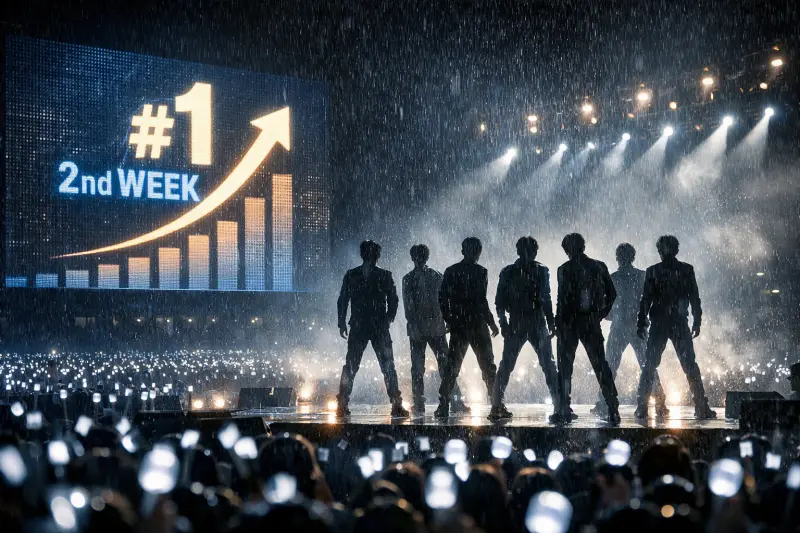
187,000. That is the number attached to BTS's second week on the Billboard 200. But the reason the market is reading it so closely goes beyond the chart headline itself. After opening with 641,000 equivalent album units, ARIRANG stayed at No. 1 for a second straight frame. That matters because it points to more than comeback hype. It suggests that U.S. demand is still active after the first-week surge, which is exactly where global pop campaigns either settle into the market or slide out of it.
Why Week Two Matters More Than Week One
187,000 units may say more than 641,000 did
Yonhap and Korea JoongAng Daily, both citing Billboard's latest chart data, reported that ARIRANG remained at No. 1 with 187,000 equivalent album units in the week ending April 2. That is down 71 percent from its 641,000-unit opening, but the interpretation is not bearish. In the U.S. market, clearing six figures in week two usually means the audience did not disappear after the fandom rush. It means the album kept enough sales and streaming momentum to outlast new competition.
Debuting at No. 1 is one story. Staying there is another.
The sharper headline is that BTS became the first K-pop act to top the Billboard 200 for two consecutive weeks. A No. 1 debut can be powered by concentrated fan spending and anticipation. A second week at No. 1 requires durability. Consumption has to keep flowing once the initial impact cools. That is why this result looks less like a one-week event and more like a market-share signal.
Why The Timing Makes The Result Bigger
Chart strength and live demand are hitting at the same moment
ARIRANG is not only performing on charts. AP reported that BTS opened its new world tour in Goyang on April 9, 2026, while Weverse posted detailed notices for on-site merchandise sales, pickup, and sound check windows running from April 8 to April 12. That overlap matters. When week-two chart strength lands at the same time as stadium demand and venue commerce, album consumption starts converting directly into ticketing, merch, and city-level spending. Related: Gwanghwamun Was the Teaser — What BTS Opened in Seoul Is Bigger Than a Tour
 When chart durability and live demand move together, an album stops being just a release and starts acting like a market engine.
The market is now seeing the length of demand, not just the size of fandom
It would be easy to flatten this into a simple BTS exceptionalism story. But what the industry is watching is duration. Many K-pop releases explode in week one and fade quickly in week two. ARIRANG did not. Even after the expected drop from its debut peak, it still held the top spot. That is the kind of pattern that tells labels, distributors, and touring partners that the product can travel beyond launch-week fandom intensity.
What This Changes For K-pop's U.S. Playbook
The benchmark is shifting from entry to retention
For years, K-pop's U.S. wins were often summarized through first-week rank and opening-sales totals. ARIRANG changes the emphasis. The stronger question now is not just how high an album enters, but how long it stays. BTS has already made seven Billboard 200 No. 1 albums, but this time the market will likely remember the second week as much as the debut. That is a signal that U.S. competition for K-pop is moving from breakthrough moments to retention battles.
How MEARROW Reads BTS's Second Week At No. 1
BTS did not just add another record. They changed the terms of evaluation.
From MEARROW's perspective, the biggest takeaway is not that BTS topped another chart. It is that the U.S. market is treating this album less like comeback curiosity and more like a repeat-consumption product. Once a second week holds, the release starts moving beyond obligation buying and into recurring listening and recurring spend. That is the threshold more K-pop companies will now chase, because flashy entry is not enough if the market clears the act out immediately after launch.
The Next Test Is Bigger Than Week Three
The real question is how far this durability travels outside the chart
Week three still matters, but the larger test sits outside the ranking itself. Can ARIRANG's momentum keep feeding touring demand, merch velocity, and platform engagement across the coming weeks? If it does, this second straight week at No. 1 will look less like a neat record and more like an early sign that the economics of K-pop's U.S. expansion are shifting again.



Comments
0Loading comments...