
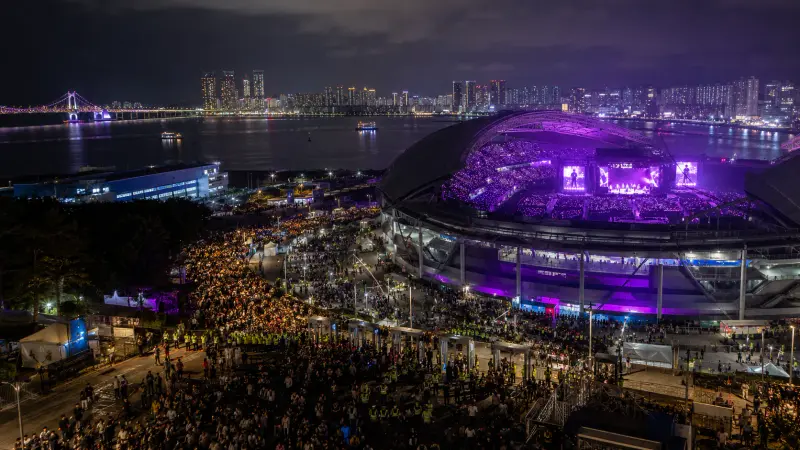
BTS Busan should have been the cleanest possible homecoming headline. Two sold-out concerts. Around 110,000 fans over two nights. The second show landing exactly on the group's June 13 debut anniversary. Busan hometown members Jimin and Jungkook returning to a city that already carries BTS history. Instead, the sharper story came from the gap between the celebration and the system holding it up. According to Yonhap, BTS wrapped its two-night Busan stop at Busan Asiad Main Stadium with emotional anniversary messages to fans. But according to The Korea Herald, HYBE also had to apologize after the first night started about 75 minutes late because entry for tens of thousands of fans was delayed. Related: BTS already turned Las Vegas and Busan into the real headline before the show even started
That combination is why this stop matters beyond one concert recap. BTS did not fail the demand test. Demand was overwhelming. The new test is whether K-pop's biggest live products can operate at city scale without turning fandom patience into an unofficial part of the ticket price.
The Anniversary Made Busan More Than Another Tour Stop
110,000 fans turned two nights into a national-scale return
Yonhap reported that BTS drew around 110,000 fans across the two sold-out Busan concerts, with the June 13 show coinciding with the 13th anniversary of the group's debut in 2013. That timing changes the meaning of the stop. A normal tour date sells a show. An anniversary date sells a shared memory.
The Busan context made that memory heavier. BTS had not performed in the city since its Yet to Come in Busan concert in October 2022, held in support of Busan's then-bid for the 2030 World Expo. In the years between, the group moved through enlistment, solo activity, reunion expectation and now the ARIRANG world tour. So this was not simply a domestic stop after overseas dates. It was the group returning to one of its most symbolic Korean stages after completing the long military-service chapter.
Khan's English report also framed the emotional setup clearly: Jimin and Jungkook called Busan special because it is their hometown, and the article noted that live viewing for the June 13 show was scheduled in more than 80 countries. That detail matters. Busan was local on the ground, but global in distribution.
The Delay Became the Bigger Business Signal
HYBE's apology shows where the pressure now sits
The first night was scheduled to begin at 7 p.m. on June 12. The show began at 8:15 p.m. instead. The Korea Herald, citing HYBE's Weverse notice, reported that the agency apologized for inconvenience caused by the delayed start and said it would strengthen overall on-site operations before the second concert.
Sports Khan's English report gave the operational texture behind that delay: audience entry issues, confusion in on-site guidance, bottlenecks in the queue during fan-gift distribution, and delays in merchandise pickup combined to push the main performance back by 75 minutes. That is not a small footnote. It is the exact point where K-pop's stadium economy becomes an infrastructure problem.
The old question was whether K-pop could fill venues this large. BTS answered that years ago. The current question is harder: can agencies, venues, transit corridors, merchandise teams, fan-benefit systems and city partners all move at the same speed as fandom demand?
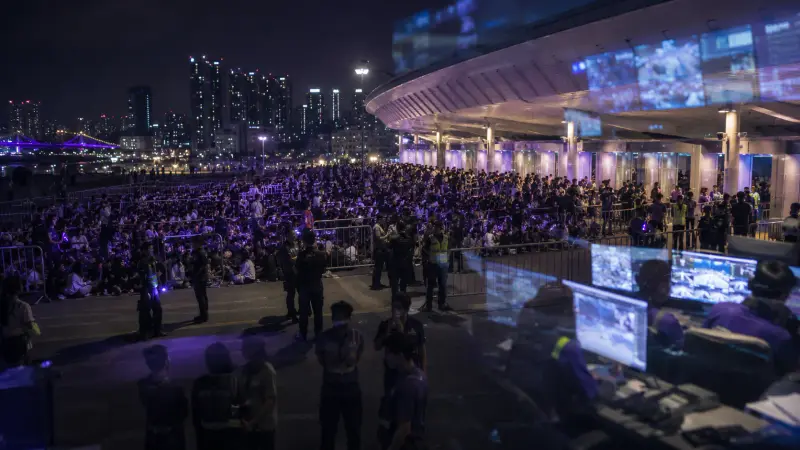 An AI-rendered editorial image of Busan concert logistics under purple stadium light.
The City Format Raises the Stakes
THE CITY turns one concert into many moving parts
This is where BTS THE CITY ARIRANG-BUSAN becomes important. Khan reported that the offline city event spread across Busan landmarks, including a drone show over Gwangandaegyo Bridge, a light show at Busan Cinema Center, and BTS messages at major sites such as Busan Eurasia Platform and the Gwangbok-ro media facade. That is exactly the kind of expansion MEARROW flagged earlier: BTS is not only selling a seat inside a stadium anymore. It is selling a full destination experience around the stadium.
That strategy is powerful because it widens the revenue map. Fans spend on travel, lodging, transport, food, retail, pop-ups, merchandise, and time inside the city. It also widens the risk map. Every added experience creates another queue, another timing dependency, another crowd-flow issue, and another place where a small bottleneck can become a headline.
In other words, the 75-minute delay was not a contradiction of the city strategy. It was the first visible stress test of it.
The bigger the fandom economy, the less invisible operations can be
For fans, a delay can feel like disrespect even when the show itself eventually delivers. For companies, that reaction is commercially dangerous because live entertainment is not only evaluated by the stage. It is evaluated by the full day: arrival, entry, waiting, restroom lines, merch pickup, fan benefits, exits, transit and post-show crowd movement.
BTS fans are unusually organized, but organization should not become free labor for the event system. If tens of thousands of fans are expected to show up early, collect benefits, buy goods and navigate city programming, then the event design has to assume that all of those behaviors will happen at once. Anything less turns loyalty into congestion.
MEARROW's Read on the Busan Signal
BTS proved demand again; HYBE exposed the next ceiling
MEARROW reads Busan as a split verdict. On the artist side, BTS' position is still extraordinary. A domestic two-night stop drawing about 110,000 fans, tied to a debut anniversary and broadcast through live viewing in more than 80 countries, is not normal artist activity. It is a national-scale fan system with international reach.
On the operator side, however, Busan shows the next ceiling for K-pop's biggest companies. The competition is moving from pure demand generation to demand handling. That sounds less glamorous than chart records or stadium photos, but it may decide which companies can scale the next decade of live K-pop.
A group like BTS can absorb one delay because the emotional bond is deep. Smaller acts cannot assume the same margin. Even for BTS, repeated friction would change the story from "historic homecoming" to "premium experience with basic execution problems." That is the risk HYBE was right to address immediately.
Busan Was a Celebration — and a Warning
The clean headline is that BTS returned to Busan, celebrated 13 years, and sent 110,000 fans into another wave of anniversary emotion. That headline is true. But the more useful headline is that the biggest K-pop act in the world just demonstrated how thin the line has become between spectacle and systems failure.
BTS' Busan homecoming proved the city-sized future of K-pop is already here. The 75-minute delay proved the operating model has to catch up just as quickly. From here, the artists may not be the limiting factor anymore. The gates, queues, pickup desks, city routes and venue playbooks might be.

Comments
0Loading comments...