
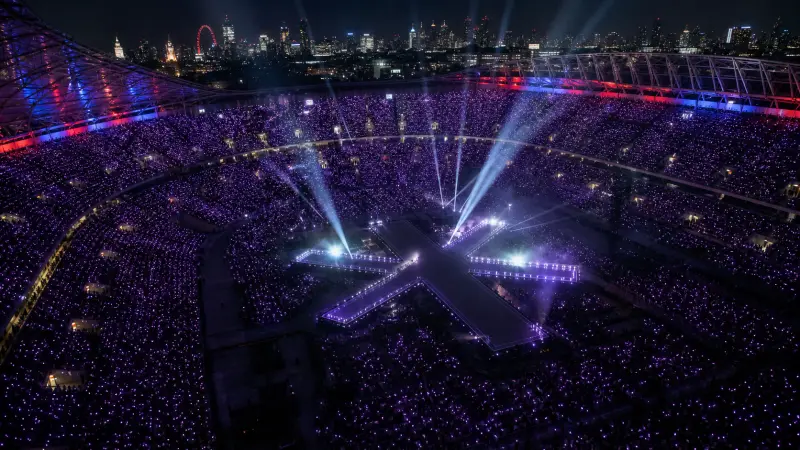
The BTS London concert story started with a promoter-reported figure: approximately 130,000 in aggregate attendance across two sold-out nights. On July 6 and 7, BTS returned to the British capital as a full group for the first time in seven years and played two sold-out shows at Tottenham Hotspur Stadium. Live Nation said the shows set the stadium's record for highest per-show attendance at a concert since it opened in 2019, according to Korea JoongAng Daily and SBS.
That would be enough for a victory-lap headline. London offered a bigger story. Fans traveled across borders, restaurants prepared special menus, Korean cultural events spread beyond the venue, and a football stadium briefly became the center of a citywide fandom map. The question is no longer whether BTS can recover its pre-hiatus demand. It is how far a concert stop can reach once the audience leaves its seat.
Live Nation called the BTS London concert a Tottenham per-show record
Two sold-out nights turned patience into a public number
The first London show drew 65,000 people; Live Nation reported aggregate attendance of about 130,000 across both nights. BBC News described the first night as the largest concert crowd Tottenham Hotspur Stadium had hosted and credited the venue's 360-degree setup for making that capacity possible. SBS separately reported the two-night total and said all tickets sold out when they were released.
The gap since BTS's previous London appearance made the number hit harder. In June 2019, the group became the first Korean act to headline Wembley Stadium. A planned 2020 return disappeared with the pandemic, followed by the members' solo work and compulsory military service. Seven years later, London did not greet the reunion like a nostalgia event. It treated the shows like a current peak.
The British reviews reinforced that reading. Korea JoongAng Daily and SBS reported five-star verdicts from both Rolling Stone UK and The Guardian, while The Times gave the concert four stars. Reviews are subjective; Live Nation's reported aggregate attendance of about 130,000 is a separate measure of demand. Together they show a comeback with both critical attention and mass demand.
The concert escaped the stadium
"BTS The City Arirang" gave fans reasons to stay in London
The weekend did not end at the turnstiles. BBC London documented the first European edition of "BTS The City Arirang," an official program built around exhibitions, pop-up stores, restaurant collaborations and cultural events. HYBE told the BBC that the project was designed to extend the concert experience into the host city.
That extension showed up in ordinary businesses. A Korean matcha cafe in Covent Garden created limited-edition Arirang matcha and dessert items and saw queues form before opening. The director of a Korean restaurant and pub in Chinatown told the BBC that customer numbers almost doubled during the program. Those examples do not establish a citywide economic total, but they make the mechanism visible: traveling fans needed food, places to meet and activities between showtimes.
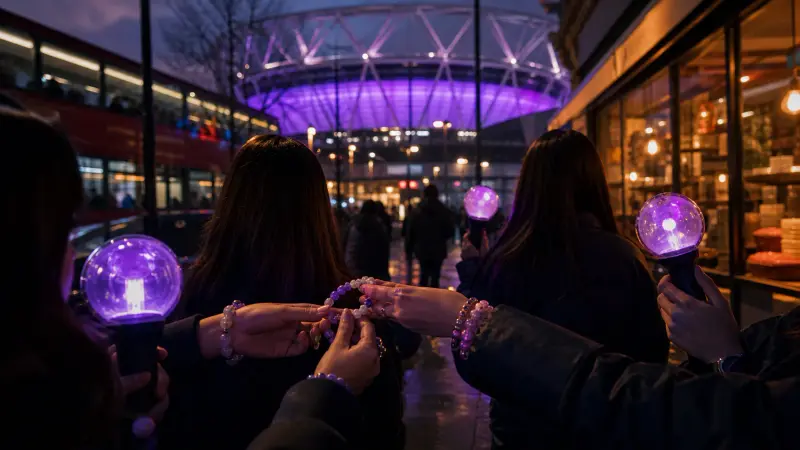 Anonymous fans exchange bracelets outside a London-inspired stadium district as nearby cafes catch the concert rush.
The most useful detail may be how fans planned the trip. BBC London spoke with visitors from Norway, as well as two friends from the United States who deliberately turned the concerts into a longer holiday. The report also documented fans exchanging handmade bracelets, photocards and small gifts with people they had never met. The stadium sold the ticket. The community filled the rest of the itinerary.
Korean culture was built into the production
The stage carried more than a set list
BTS did not arrive in London with a culturally neutral stadium package. The BBC reported that the opening used the sound of the sacred bell of King Seongdeok and that the stage drew visual inspiration from Gyeonghoeru Pavilion at Gyeongbokgung Palace. The floor design also referenced elements of the South Korean flag. Those choices placed the album's Korean identity inside the biggest visual frame of the night.
The set moved between new Arirang tracks and older songs such as "Fire," "Idol" and "Dynamite." This mattered because the reunion had two jobs. It had to reward fans who waited through the hiatus, and it had to prove that the current BTS could carry a stadium without surviving only on memory. The production answered by letting the catalog and the new Korean-rooted concept share the same stage.
Related: BTS's Gwanghwamun comeback turned a city square into a global launchpad
The London weekend was therefore less a copy of Wembley 2019 than a revision of it. Wembley established that a Korean group could headline a British landmark. Tottenham showed what happens when the concert becomes the anchor for a larger cultural program.
Fans became the distribution network
The light sticks were only the visible layer
A reported aggregate attendance of about 130,000 across two nights is impressive, but the behavior around it explains why the number traveled so widely. Fans carried the event beyond the stadium through gift exchanges, restaurant visits and conversations with strangers. None of that required a second stage. It required a reason to keep participating.
That is where BTS still has an advantage that raw streaming numbers cannot fully describe. The fandom can turn a tour stop into a temporary social system. BBC London observed fans exchanging bracelets and other gifts, while one visitor said fans could begin talking without knowing one another and connect immediately through the music.
There is also a business lesson for smaller artists. A city takeover is not created by printing more merchandise after a venue sells out. It starts with a fan culture that already has rituals people want to practice together. The official program can organize those rituals, but it cannot fake the trust underneath them.
MEARROW's view: a stadium show is now a platform
The next touring race will be measured outside the venue
MEARROW reads the London result as a change in what a top-tier K-pop tour is expected to do. Ticket sales remain the gate. The stronger model uses the concert as a platform that connects travel, food, retail, fan-made exchange and local cultural institutions. A stadium performance can then support several days of attention without asking fans to spend longer at the venue.
That creates opportunity and pressure. Host cities gain visitors and cultural activity. Korean businesses get a concentrated audience. Fans receive more ways to meet. But every extra pop-up and collaboration also competes for the same wallet. If the surrounding program becomes a shopping obstacle course, the warmth that made it valuable will disappear.
London worked because the commercial layer sat beside visible community behavior. The image that lasts is not only a packed stadium. It is a cafe queue, a bracelet passed between strangers and Korean words spoken by fans far from Seoul. Those moments made the reported aggregate attendance of about 130,000 feel human rather than abstract.
The Tottenham per-show record is a starting line
Paris, North America and the next host cities now inherit the test
BTS left London with what Live Nation described as Tottenham Hotspur Stadium's highest per-show concert attendance since the venue opened in 2019 and continued on the "Arirang" world tour. The harder standard will follow them. Future stops will be judged not only by attendance, but by whether the surrounding city feels included or merely rented for the night.
Tottenham proved the reunion demand. London proved something more useful: BTS can still turn waiting into movement, and movement into a temporary economy of culture and connection. When two concerts draw a reported aggregate attendance of about 130,000 and the story continues in cafes, streets and fan exchanges, "comeback" starts to sound too small. The better word is takeover, provided the city and the fans still feel like participants rather than props.


Comments
0Loading comments...