
At 1 PM KST today, Gwanghwamun Square turned purple.
BTS took the stage in front of Heungnyemun Gate of Gyeongbokgung Palace for a comeback concert that made history in multiple ways. It was the first time any K-pop act has ever performed at this 600-year-old landmark in the heart of Seoul. Streamed live on Netflix to 190 countries — free for all subscribers — this was what Netflix itself described as "the biggest watch party in the world." It was also BTS's first full OT7 performance since their "Yet to Come" concert in Busan in October 2022, ending a wait of approximately 1,250 days.
Why Gwanghwamun Matters
Six Hundred Years of History, One K-Pop Stage
Gwanghwamun Square is not just a plaza. It stands at the main gate of Gyeongbokgung Palace — the royal palace of the Joseon Dynasty, the seat of Korean power for 600 years. Throughout modern Korean history, this space has hosted candlelight vigils, presidential ceremonies, and national celebrations. It is where Korea's most consequential public moments have played out.
For BTS to perform here was not a venue decision. It was a statement. The album is called ARIRANG — named after Korea's centuries-old folk song, once sung by people separated from their homeland. The stage design completed that message: Gyeongbokgung as backdrop, the music of Joseon-era bells, seven members walking out along the palace wall. K-pop's global language translated back into its Korean roots.
Netflix VP of Nonfiction Series and Sports Brandon Riegg called Saturday's event "a spectacle unlike anything we've seen before" and indicated Netflix plans to expand live event programming in South Korea following this partnership.
The Seongdeok Bell and the Comeback Ritual
According to reports from the venue, the concert opened with the recorded sound of the Seongdeok Bell — the famous Emile Bell of the Silla Dynasty — resonating across the square, before the members emerged from within the palace grounds. The visual: seven figures stepping through a gate built in the 1390s. The sound: K-pop's biggest act returning to its cultural source.
For ARMY who have been waiting since October 2022, the image was reportedly enough to make fans worldwide cry before a single note of music was played.
1,250 Days: The Numbers Behind the Return
BTS's last full group performance was the "BTS 2030 Busan World Expo" concert at Busan Asiad Main Stadium on October 15, 2022. Between then and today's Gwanghwamun concert: approximately 1,250 days.
Military service timeline:
- Jin: Enlisted Dec 2022 → Discharged June 2024
- j-hope: Enlisted Apr 2023 → Discharged Oct 2024
- RM, V: Enlisted Dec 2023 → Discharged June 2025
- Jimin, Jung Kook: Enlisted Dec 2023 → Discharged June 2025
- SUGA: Social service worker from Sep 2023 → Released June 2025
By June 2025, all seven members were civilians again. Nine months of preparation followed. Today, they stood at Gwanghwamun.
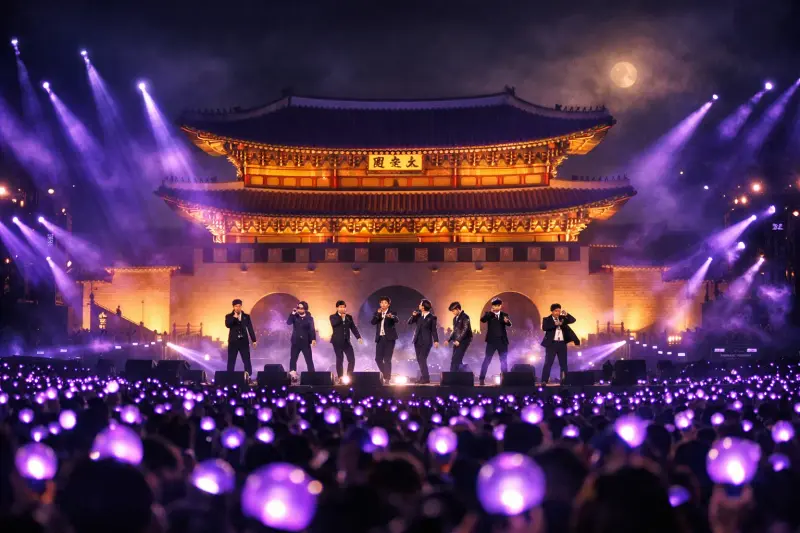 Image: AI generated via ChatGPT
Netflix Partnership: A New Distribution Model for K-Pop
Free for 300 Million Subscribers
The decision to stream this concert exclusively on Netflix — rather than YouTube, Weverse, or Mnet — represents a structural shift in how K-pop reaches global audiences.
Netflix made the concert available free to all subscribers in 190 countries. No extra fee, no pay-per-view gate. With approximately 300 million Netflix subscribers worldwide, even a fraction tuning in would shatter every K-pop live viewership record. Netflix's largest previous live sports events were boxing matches. BTS now sets a K-pop benchmark against those figures.
The implications are significant: Netflix delivers BTS to viewers who are not already K-pop fans. A subscriber who discovers BTS through a Netflix recommendation feed is a fundamentally different audience pathway than a fan who follows HYBE's official channels. This is K-pop reaching outside its own fandom ecosystem.
The Full Netflix Arc
The Netflix partnership extends well beyond today's concert:
- March 20: Fifth studio album ARIRANG released
- March 21: Gwanghwamun Comeback Live (today, streamed on Netflix)
- March 27: BTS: The Return documentary drops (directed by Bao Nguyen)
- April onward: ARIRANG World Tour begins (34 regions, 82 shows)
This is not a music release — it's a content franchise. Album → concert → documentary → global tour. BTS has become a Netflix IP partner on par with major sports franchises and prestige entertainment properties.
ARMY Reaction: The World Watched and Wept
"#BTS광화문" Goes Global
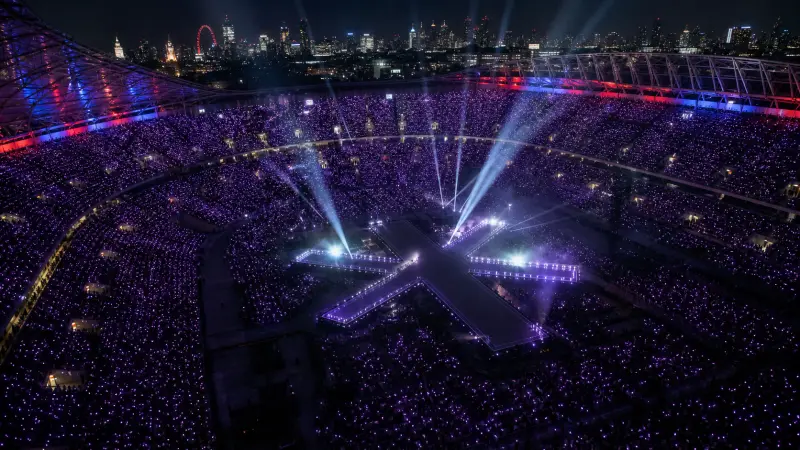
From the moment the concert began, social media was overtaken by ARMY. On X (formerly Twitter), #BTS광화문, #BTSComeback, and #ARIRANG simultaneously trended globally. Fan-shared clips of the Gwanghwamun crowd showed a sea of purple Army Bombs stretching back as far as the camera could see, the historic palace gate glowing behind the stage.
International fans watching on Netflix described the experience: solo viewing parties in living rooms, group watch parties in fan community spaces, and shared livestream watch-alongs in cities from New York to São Paulo to Jakarta. "I told myself I wouldn't cry," read one post that accumulated hundreds of thousands of engagements. "I was wrong from second one."
On the Ground in Seoul
Reports from the venue indicate tens of thousands of fans gathered at Gwanghwamun Square and along the surrounding Sejong-daero boulevard. Seoul city authorities and police implemented pre-planned crowd management protocols. Gwanghwamun Station and Gyeongbokgung Station on Seoul Metro Line 5 were reported to have managed entry flow due to the volume of attendees.
Major international outlets — AP, BBC, Reuters, the New York Times — sent correspondents to the scene. The New York Times published a piece framing the concert as part of a broader shift in the K-pop landscape since BTS's departure, noting how the genre "roared back" with properties like KPop Demon Hunters in their absence, and now faces the arrival of the architects of its global ascent.
What This Means for the K-Pop Industry
The Distribution Equation Has Changed
BTS's Netflix partnership is a proof of concept for the entire K-pop industry. If a BTS concert can become a Netflix live event on par with major sports programming, it reframes what K-pop concerts can be — and where they can be distributed.
Traditionally, K-pop live events have lived on YouTube (free, ad-supported, fandom-driven) or behind paywalls on V Live / Weverse (fandom subscription models). The Netflix model introduces K-pop into living rooms of subscribers who never sought it out. It is the difference between preaching to the choir and broadcasting to a continent.
Expect other K-pop agencies to explore similar partnerships. SM Entertainment, JYP, and YG all have artists capable of comparable live events. BTS and HYBE have set the precedent.
MEARROW Perspective: HYBE's Firepower Index
In MEARROW (K-pop Talent Network) terms, HYBE's Firepower Index — which tracks combined artist activity, global engagement, and market influence — is tracking for a sharp upward movement. BTS's return to active status with a concurrent Netflix partnership, world tour, and new album is a multi-vector activation: album sales, streaming numbers, concert revenue, Weverse traffic, and HYBE stock price all moving simultaneously.
Competitor agencies face a familiar challenge: when BTS is active, the global spotlight narrows. Hearts2Hearts (SM), Stray Kids and NMIXX (JYP), and BLACKPINK's anticipated comeback (YG) must all compete for airspace in a cycle dominated by BTS. This is not unprecedented — BTS has always created this gravity — but 2026 represents its return after the longest K-pop had ever operated without them at full force.
The ARIRANG World Tour: What Comes Next
Gwanghwamun was the opening chapter. The ARIRANG World Tour is the book.
- Scale: 34 regions, 82 shows
- Duration: April 2026 through March 2027
- Expected markets: Seoul (additional dates), Tokyo, Osaka, New York, Los Angeles, Chicago, London, Paris, São Paulo, and others
BTS's last full stadium tour — LOVE YOURSELF: SPEAK YOURSELF in 2019 — generated approximately $116.8 million USD and became the highest-grossing concert tour of that year by a Korean act. With a larger post-pandemic demand, 82 shows, and 34 regions, analysts project this tour could reach $250–300 million USD in gross revenue.
The BTS: The Return documentary on March 27 will serve as the bridge: capturing the military service years and the preparation for the comeback, it will convert Netflix viewers — who may have just watched the concert for the first time — into tour ticket buyers.
A Final Note: History Was Made Tonight
March 21, 2026. The name Gwanghwamun now belongs to BTS, too.
In a square where Korea has marked its most significant moments across six centuries, seven men who left separately returned together. The album is called ARIRANG — the song of people separated from what they love, who sing to keep the memory alive until they find their way back.
ARMY kept the memory alive for 1,250 days. Tonight, in Gwanghwamun, BTS found their way back.
The world tour starts in April. The story is just beginning.
Related: ARIRANG Day 1: Spotify hits 5M pre-saves, Netflix concert sparks ARMY debate


Comments
0Loading comments...