
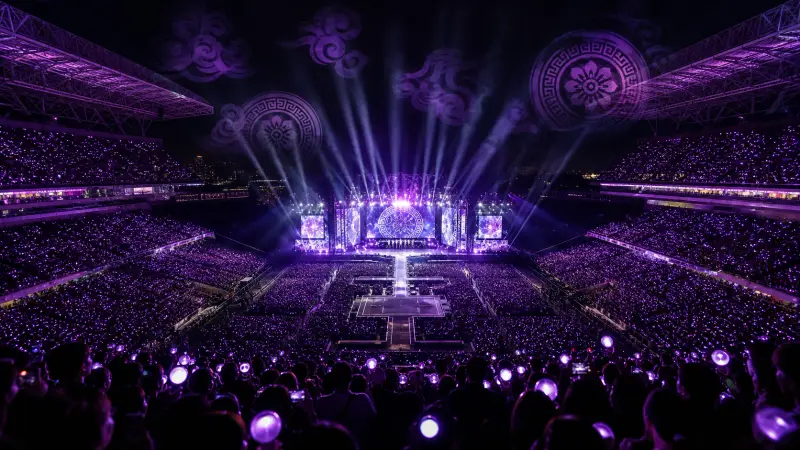
BTS Tampa was supposed to look like a triumphant return. It ended up looking bigger than that. Over April 25, April 26, and April 28, BTS filled Raymond James Stadium for three sold-out nights and drew about 190,000 fans, according to BigHit Music figures carried by Korea JoongAng Daily and CHOSUNBIZ. The raw attendance number is already enough to dominate a headline. The deeper signal is that the group did not reopen the American leg of the ARIRANG era by diluting its core idea. It doubled down on it, and a U.S. stadium crowd followed. Related: BTS Sold Out 41 Stadiums Before Playing a Single Note - The $1.87 Billion Tour Chasing Taylor Swift's Record
That is what gives this moment weight inside the wider BTS North America tour conversation. A comeback can sell because fans have been waiting. A stadium run of this size has to do something more demanding: justify the wait with scale, atmosphere, and a sense that the new era is not simply repeating old muscle memory. In Tampa, BTS looked less like a group testing whether demand still exists and more like an act measuring how much bigger that demand has become while nobody was watching.
The 190,000 Figure Was Only The First Headline
Three nights turned a reunion into compressed demand
The calendar alone tells you why this stop hit so hard. These were BTS's first U.S. concerts in about four years, and they did not restart gently. Korea JoongAng Daily reported that the group opened the North American leg at Raymond James Stadium, while CHOSUNBIZ matched the core fact pattern: all three Tampa shows sold out, and the three-night run reached roughly 190,000 spectators. That is not a normal warm-up city, and it is not a normal warm-up number.
What makes the figure more interesting is how little it behaves like a nostalgia spike. Nostalgia can fill one symbolic show. It can produce emotional clips, expensive resale markets, and a short burst of think pieces about legacy. Tampa looked different. Three separate nights means repeated conversion. It means people organized travel, lodging, merch spending, and schedule changes across a multi-day event. It means the fandom did not show up only to witness a reunion. It showed up ready to operate at full stadium-tour discipline.
That matters because the easiest version of this story is that BTS came back and, being BTS, sold a lot of tickets. The more useful version is that the gap created by military service may have compressed demand rather than weakened it. When a group disappears, the commercial risk is usually erosion: casual listeners drift, live habits cool, and the market reallocates attention elsewhere. Tampa suggests the opposite effect. The absence may have thickened the appetite.
The Cultural Bet Worked In Front Of A U.S. Stadium Crowd
The singalong mattered more than the attendance graphic
Attendance proves scale. Audience behavior proves meaning. That is where Tampa became more revealing than a big box score. CHOSUNBIZ described fans welcoming BTS with coordinated chants and large-scale group singing, while Korea JoongAng Daily noted that the set mixed material from the latest studio album ARIRANG with catalog staples such as MIC Drop and Fake Love. In other words, the show was not built as a museum piece. It asked the crowd to move between the old global-language hits and a new era grounded more explicitly in Korean identity.
That balance is the real story. Plenty of global pop acts can turn a stadium into a shared singalong. Far fewer can do it while centering a concept that leans into Korean cultural memory instead of sanding it down for export. ARIRANG is not a random album title. It carries historical and emotional weight before the first beat even lands. When that framing travels into a U.S. stadium and still feels legible at mass scale, the business lesson changes. K-pop does not always need to universalize by flattening itself. Sometimes it scales by asking the audience to come closer.
That is why the Tampa footage landed so quickly online. Fans were not only reposting stage spectacle. They were reposting proof of translation: proof that a show anchored in a distinctly Korean idea could still feel enormous, pop-forward, and stadium-ready in Florida. That is a stronger signal than another "BTS still sells out" headline, because it suggests the group's newest phase is not relying on brand familiarity alone.
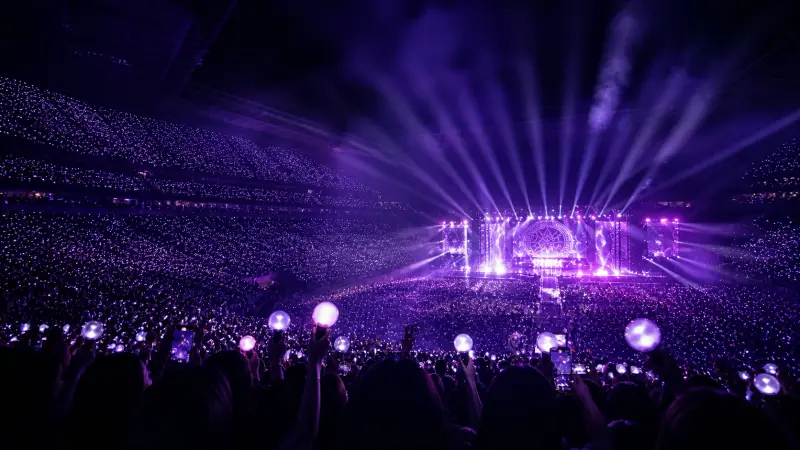 An AI-rendered editorial image capturing the stadium-scale singalong energy around BTS's Tampa stop.
The North American Leg Already Looks Like Infrastructure
Thirty-one shows across twelve cities changes the scale
The Tampa stop also lands differently once you place it inside the full North American map. Back on January 27, Korea JoongAng Daily reported that the announced North American leg covered 31 shows across 12 cities in the United States, Canada, and Mexico, with those dates sold out as announced. The April 29 tour update repeated the core point that the North American dates were sold out. By the time Tampa opened, this was no longer a story about one explosive restart. It was a story about a routed continental system.
That distinction matters because stadium pop in America is not won by one city. It is won by repeatability. A blockbuster weekend in Los Angeles or New York can always be explained away as density, prestige, or inevitability. A long stadium route asks a different question: can you keep the machine hot across regions, travel corridors, and very different local crowd conditions? That is a harder test, and it is the one BTS is taking.
It also changes how other agencies read the market. If the biggest K-pop act in the world can mobilize this kind of attendance across a spread that includes not just obvious global hubs but multiple U.S. stadium corridors, then the American market starts looking less like a prestige add-on and more like structural revenue terrain. For smaller companies, the conclusion will not be "be BTS." It will be that the old assumptions about where K-pop can safely scale in North America need updating.
El Paso Is The Quietly Historic Next Stop
First Korean act at Sun Bowl is not trivia
After Tampa, BTS moved on to Sun Bowl Stadium in El Paso, Texas for May 2 and May 3. Korea JoongAng Daily and CHOSUNBIZ aligned on the key fact: BTS is the first Korean act scheduled to perform at the venue. Local station KVIA separately confirmed the dates and showed how much logistical planning goes into bringing a tour of this size to El Paso, from venue operations to regional visitor flow.
That venue milestone deserves more attention than it is getting. Coastal capitals already understand how to host global K-pop demand. El Paso tells a different story. It is a border-city test of whether BTS can pull destination-level attention into a market that does not usually sit at the center of English-language K-pop coverage. If Tampa proved the scale, El Paso sharpens the geography. This is not only about dominating the cities everybody expects. It is about redrawing which American cities count as viable K-pop stadium territory.
That is one reason the Sun Bowl stop feels more strategic than decorative. A group that can normalize stadium behavior in places outside the most obvious pop capitals gives the whole industry new planning data. Promoters watch that. Local governments watch that. Competing agencies definitely watch that. When the first Korean act enters a venue with this level of civic preparation around it, the result is not merely symbolic. It becomes a case study.
MEARROW's View On BTS's Tampa Signal
The ceiling question in America has changed
MEARROW does not read Tampa as proof that BTS remains popular. That argument is too small for the evidence on the table. The sharper takeaway is that BTS is helping move K-pop deeper into the American stadium grid without stripping out the Korean center of the product. That combination is what makes this moment commercially dangerous for everyone else. It raises the bar on two fronts at once: scale and specificity.
For years, one of the quiet fears around K-pop expansion was that the farther the genre traveled, the more it would need to translate itself into something softer, blander, or more legible to mainstream U.S. pop grammar. BTS's Tampa stop suggests a more powerful route. The group can bring the audience to its concept instead of running from the concept for safety. That does not mean every act can do the same thing tomorrow. It does mean the most successful act in the field is expanding the range of what now looks possible.
There is also a practical industry consequence. If the BTS Tampa turnout and the El Paso follow-up hold their narrative force across the rest of the U.S. run, planners will have a harder time treating American demand as something concentrated only in the biggest coastal media markets. The map gets wider. The logistics get more ambitious. The ceiling lifts again.
The Tour Is Now Testing Repeatability, Not Relevance
Tampa answered the easiest question
The easiest question surrounding BTS in 2026 was whether people still cared enough to show up after the long break. Tampa answered that immediately. The harder question is whether the ARIRANG era can keep turning Korean-rooted symbolism, catalog power, and stadium-scale live design into a repeatable North American rhythm across city after city. That is the level this tour is operating on now.
Even so, one conclusion already looks hard to avoid. Over three nights in late April, BTS did not simply relaunch its U.S. live business. It demonstrated that the audience waiting on the other side of the hiatus was still massive, still organized, and still willing to meet the group on its own terms. 190,000 in Tampa is the headline. The real message is what sat underneath it: BTS is no longer asking whether America will listen. It is testing how far America will follow.


Comments
0Loading comments...