
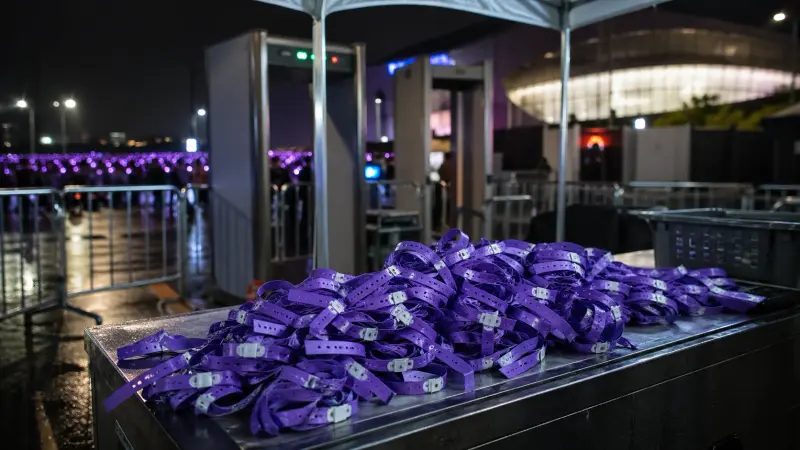
At 3:20 p.m. on April 11, the biggest problem around BTS's Goyang concert was suddenly not the weather, the set list, or the resale market. It was the wristband.
Police said a man fled with about 500 admission wristbands from a ticket booth at the auxiliary stadium of the Goyang Sports Complex, just hours before one of the most tightly controlled concert entries in Korea was supposed to work as designed. On paper, that sounds like a strange side incident. In practice, the BTS wristband theft story exposed something more serious about K-pop concert security: once a tour reaches BTS scale, even a low-tech object can become a pressure point for the whole live system. Related: BTS turned Seoul into a market, not just a tour start
What Actually Happened in Goyang
The theft was reported before entry operations were fully underway
Korea JoongAng Daily, The Asia Business Daily and CHOSUNBIZ all aligned on the core timeline. Around 3:20 p.m. on April 11, a report came in that a man had taken roughly 500 wristbands from the ticket booth area at Goyang Sports Complex in Ilsanseo-gu and fled. Police began tracking the suspect based on witness descriptions and nearby-route searches. That part is simple enough. The harder point is what those wristbands were for. They were not souvenirs. They were part of the venue authentication chain.
BigHit's response made the risk clear immediately
CHOSUNBIZ and Asiae both reported BigHit Music's same-day response: wristbands obtained without going through the official identity-verification process would not be valid for entry, and fans were told not to accept or buy any wristbands being offered outside the designated booth. That statement did two things at once. First, it tried to contain panic by saying a stolen band alone should not unlock the venue. Second, it quietly confirmed how sensitive the system was. If the company had to warn people in real time not to trust a wristband, then the wristband was obviously carrying real admission value in the public imagination.
Why the Wristband Mattered So Much
Goyang's anti-scalping design depended on physical verification
This concert weekend was never meant to operate like a casual walk-in event. Weeks earlier, the Culture Ministry said it had identified 1,868 resale posts tied to BTS's Gwanghwamun and Goyang performances, and four of those posts allegedly tried to flip 105 tickets at inflated prices. JoongAng's March 11 reporting and its March 17 event guide both described the same answer: one ticket per person, strict on-site identity matching, and wristbands that could not simply be removed and reattached once issued. The wristband was the final visible proof that the earlier verification step had already happened.
That turns a theft into an operations problem, not just a crime blotter
Once 500 of those bands disappear, the question is no longer only whether the thief gets caught. The question becomes whether gate staff can confidently distinguish legitimate attendees from people trying to exploit confusion during a high-volume entry window. Even if organizers invalidate the stolen batch internally, the theft still creates friction. Fans hear "wristbands stolen" and wonder whether their own verification will slow down, whether scammers will start circulating fake offers, and whether the entry line itself becomes the place where the whole system gets stress-tested in public.
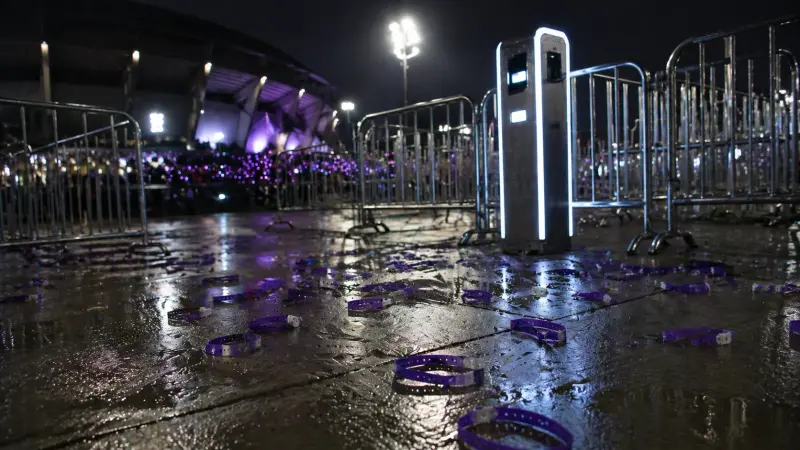 The object itself was small. The vulnerability it revealed was not.
Why This Became Industry News So Fast
BTS was operating at a scale where small failures stop being small
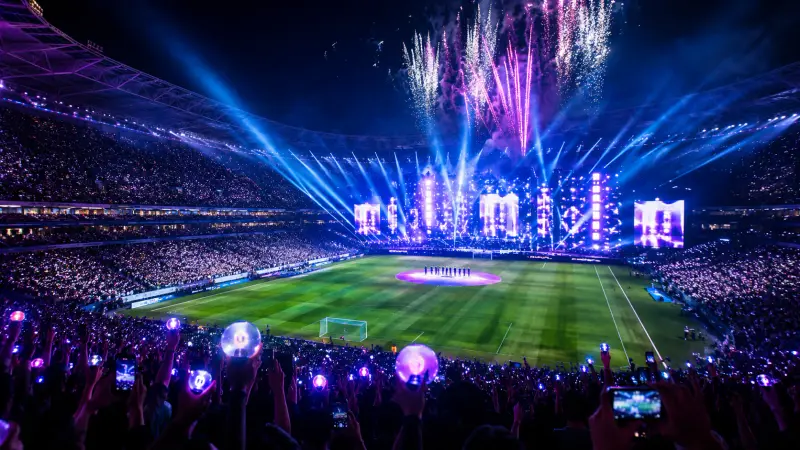
The Goyang run drew approximately 132,000 concertgoers across three nights, or about 44,000 people per show, according to Korea JoongAng Daily's April 13 coverage. That is already enough volume to make every checkpoint consequential. Add heavy rain, long queue times, merchandise traffic, language diversity, and the emotional intensity of a comeback-era BTS crowd, and the margin for operational noise gets thin very quickly. A missing box of wristbands at a smaller event is a headache. At a BTS concert, it is a signal flare.
The world-tour numbers explain why the story has legs
Before the Goyang shows had even fully cleared, JoongAng reported that 46 tour dates were already sold out and that 2.4 million tickets had been moved for 41 North American and European dates alone, citing Live Nation. That scale matters because the Goyang incident does not live inside Korea only. It reframes how people read every upcoming checkpoint on the BTS world tour and, by extension, every K-pop mega-tour leaning harder on anti-scalping systems, physical authentication, and crowd-control choreography. Once fans see a breach happen at the launch site, they stop assuming the process is airtight elsewhere.
MEARROW's View on the Real Weak Point
K-pop has scaled its tours faster than it has matured its gate infrastructure
MEARROW does not read this as a one-day oddity. The more revealing interpretation is that K-pop's live business has become elite in demand generation and increasingly sophisticated in monetization, but still uneven in the physical mechanics of entry control. Ticket restrictions got stricter. Identity checks got tougher. Government anti-scalping measures got louder. Yet the system still rested on one of the simplest objects in the chain being handled flawlessly under pressure. That is exactly the kind of mismatch that only becomes visible when an artist reaches the outer edge of the market.
Security confidence is part of the premium product now
Fans are no longer paying only for the music. They are paying for the belief that the system around the music is secure, fair, and harder to manipulate than the resale economy outside it. Once that belief cracks, the damage is not limited to one stolen batch of bands. It touches trust. It makes every future queue, verification booth, and last-minute policy notice feel slightly less stable. In that sense, the theft was not important because 500 people were suddenly getting in for free. It was important because it made the machinery look human at exactly the moment BTS's tour was supposed to look untouchable.
The Gate Is the Story Now
The concert started on time, but the warning already landed
BTS still performed. Goyang still filled. The weekend still looked enormous from the stage. But the more durable story may be what happened before the lights went down. A comeback-era BTS tour is now so large that admission control itself can become news with global search value. That is the real lesson from Goyang. In 2026, BTS concert security is no longer background logistics. It is part of the product, part of the risk, and part of the story fans will keep watching long after one missing box of wristbands is forgotten.

Comments
0Loading comments...