

The moment you board that flight to Korea, the real battle begins.
A 14-year-old girl from Bangkok, Thailand was the only person accepted out of 4,000 auditioners at YG Entertainment. A girl raised in Melbourne, Australia walked into an SM practice room without knowing a single word of Korean. A young woman from Senegal flew halfway across the globe to become the first African K-pop idol. What they all have in common: they chased their dreams across borders. But passing the audition wasn't the end — it was just the beginning.
Foreign Trainees by the Numbers
The globalization of K-pop is no longer just a slogan. The data proves it.
According to an exclusive Korea Herald report, approximately 28% of trainees at HYBE are non-Korean nationals — the highest ratio among the Big 4 agencies, reflecting HYBE's strategic investment in cultivating global artists. Zoom out to the industry level and the numbers are even more striking: as of 2023, foreign trainees make up roughly 30% of all trainees at Korean entertainment agencies, and approximately 1 in 5 active K-pop idols (about 20%) hold foreign citizenship.
Over the five years from 2018 to 2023, the number of foreign members in K-pop groups increased by 30%. JYP launched localized projects like NiziU (Japan) and A2K (USA). SM placed Chinese-born NingNing in aespa, and HYBE filled &TEAM with 8 Japanese members. K-pop is no longer "music made by Koreans" — it's evolving into "global music born from the Korean system."
The Visa Wall — Enter the K-Culture Training Visa
The first barrier any international trainee must overcome to begin training in Korea is the visa.
Previously, there was no dedicated "trainee visa." Most foreign trainees entered Korea on Student Visas (D-2) or Language Training Visas (D-4-1), then navigated the complicated process of switching to an Arts & Entertainment Visa (E-6) after signing with an agency. The catch: E-6 visas are difficult to obtain at the trainee stage, since you're technically an "aspirant," not an "artist."
To address this, the South Korean government introduced the K-Culture Training Visa. Widely covered by CNN, Korea Herald, and other international media, this visa opens the door for aspiring artists to receive K-pop training in Korea without a prior agency contract or audition pass. According to the Ministry of Justice, applicants need to "demonstrate genuine interest in Korean cultural training and fulfill basic documentation requirements."
But reality remains tough. Even with a visa, housing, training fees, and living expenses are entirely self-funded. Freelance trainees without agency backing receive no structured support, and those who fail to sign with a company before their visa expires must return home.
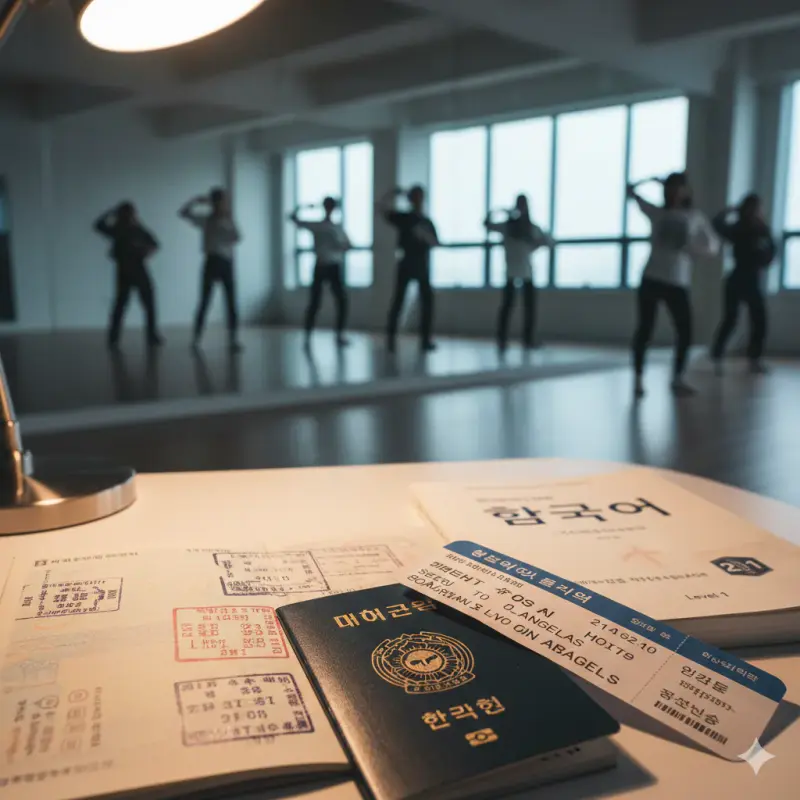 Between visa documents and passports begins the long journey of a K-pop trainee
The Language Barrier — "If You Can't Speak Korean, You Can't Even Receive Feedback"
Even after sorting out the visa, foreign trainees face what many describe as the most painful wall of all: the Korean language.
Kathy Lee, a Canadian-Korean who participated in Mnet's survival show "Produce 101," recalls:
"When trainers gave feedback in Korean, I could barely understand half of it. Everyone else corrected themselves immediately, but I just stood there frozen. That feeling of isolation... I can't put it into words."
Daily communication in the practice room, understanding trainers' real-time feedback, building relationships with fellow trainees — everything hinges on Korean fluency. Major agencies provide Korean lessons 3-5 times per week for foreign trainees, but squeezing in language study between 8-12 hour daily training schedules feels like an impossible luxury.
The language barrier becomes especially critical during vocal recording and rap training. The subtle nuances, pronunciation, and emotional delivery of Korean are challenging even for native speakers. BLACKPINK's Lisa started her trainee life at YG without knowing any Korean, and reportedly spent nearly all her energy during the first year just learning "survival Korean."
Culture Shock — Hierarchy, Food, and the Fight Against Loneliness
After language, the next force that hits foreign trainees is culture shock.
The seniority system poses the biggest challenge. For trainees raised in Western cultures, Korea's age-based hierarchy — formal speech levels, the oppa/unnie/hyung/noona address system — is an entirely foreign world. Kathy Lee shared: "Korea's seniority culture is so strong. It was really hard to adjust at first. I made many mistakes and got scolded for them."
The strictness of dormitory life is equally jarring. In a BBC interview, former trainee Euodias revealed the reality of agency dorms: boys and girls are strictly separated, leaving without permission is forbidden, and phones are sometimes confiscated every night. For teenagers accustomed to freedom back home, these rules create enormous psychological pressure.
Differences in food and lifestyle are impossible to ignore. Spicy Korean food, the fast-paced eating culture, no personal space in communal living. And above all, the crushing loneliness from being separated from family. One 17-year-old Japanese trainee, featured in a CNN report as the only non-Korean trainee at her agency, described the pressure as "relentless."
Survival Strategies of Idols Who Shone Beyond Borders
Despite all these barriers, there are international idols who broke through to become global superstars. Their strategies share a recognizable pattern.
Lisa (BLACKPINK, Thailand) — Joined YG at 14, beating odds of 4,000:1. She arrived knowing zero Korean but set herself a rule: "2 hours of Korean self-study every day." Within 3 years, she was fluent. As YG's first non-Korean trainee, she overcame the pressure by "practicing twice as hard as everyone else."
Rosé (BLACKPINK, New Zealand/Australia) — Growing up in Australia with English as her first language, she moved to Korea after passing YG auditions and endured 4 years as a trainee. She worked to correct her strong Australian-accented Korean and turned cultural differences into her own unique charm.
Fatou (BLACKSWAN, Senegal/Belgium) — Made history as the first African-born K-pop idol. She experienced perhaps the widest gaps in appearance, language, and culture of any foreign trainee, yet held firm to her belief that "K-pop is about passion, not nationality."
Their common strategies can be distilled into three principles: 1) Never give up on Korean, 2) Don't reject the culture — absorb it, 3) Work twice as hard as everyone else.
MEARROW's Perspective on the Global Trainee Era
MEARROW's agency ranking data reveals a fascinating correlation: groups with higher percentages of foreign members tend to show stronger global streaming metrics. The fact that HYBE — which actively operates multinational groups like &TEAM (8 Japanese members), ENHYPEN (2 Japanese members), and NiziU (all Japanese) — leads in global revenue growth is no coincidence.
The future of K-pop will be determined not by "where you're from" but by "how prepared you are." MEARROW tracks this flow of global talent through data, providing objective analysis of each agency's global strategy and its outcomes.
If Your Dream Can Cross Borders
The path for international trainees is undeniably tough. Days of wrestling with visa paperwork, feeling isolated in an unfamiliar language, and being shaken by culture shock await. But in 2026, the K-pop industry is opening its doors to international talent wider than ever before. The new K-Culture Training Visa, expanded global auditions by major agencies, and updated standardized trainee contracts are all proof.
Lisa was 1 in 4,000. Fatou was the first from an entire continent. You could be next. What matters isn't your nationality — it's the heart that refuses to give up.



Comments
0Loading comments...