
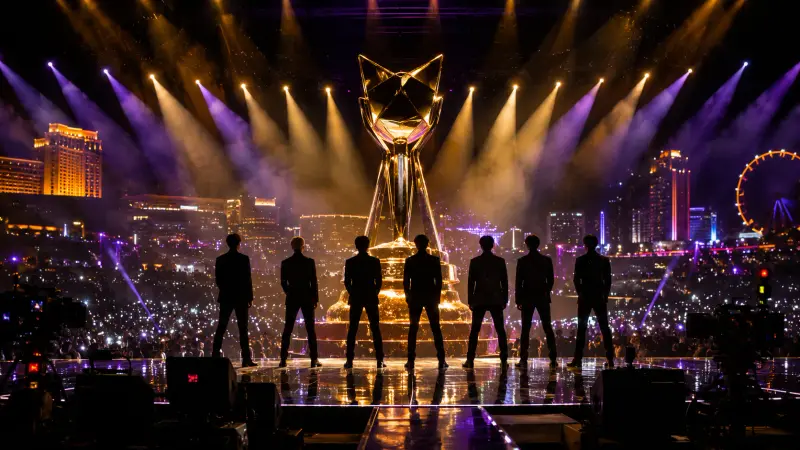
BTS AMAs 2026 did not end as a nostalgia headline. It ended as a scoreboard problem for every act still treating K-pop as a side lane. On May 25 in Las Vegas, BTS won Artist of the Year at the 52nd American Music Awards, beating a main-field lineup that included Taylor Swift, Bad Bunny, Bruno Mars, Harry Styles, Lady Gaga, Kendrick Lamar, Justin Bieber, Morgan Wallen, and Sabrina Carpenter. That is why this win lands differently from a routine fan-vote celebration. It reopened the same question BTS forced in 2021, but with a sharper answer: after military service, after a full-group pause, after years of U.S. award shows learning how to box Korean acts into dedicated categories, BTS still walked back into the biggest room and left with the biggest trophy. Related: BTS turned the AMAs' missing word into a countdown
BTS AMAs 2026 Turned A Tease Into A Trophy
The vague "special appearance" became the loudest result
Before the ceremony, the AMAs had given fans a phrase built for speculation: special live appearance. It was precise enough to confirm BTS would be part of the broadcast, but vague enough to keep everyone arguing about whether the group would attend, present, perform, or simply appear on screen. That wording mattered because BTS and the AMAs already share a long history. Their 2017 DNA stage turned the show into a U.S. television milestone for Korean pop, while their 2021 Artist of the Year win became one of the clearest proof points of K-pop's mainstream arrival.
The twist is that the 2026 show did not need to resolve the suspense in a normal way. Reuters reported that the broadcast opened with a pre-recorded Hooligan performance from BTS's Las Vegas stop on the ARIRANG tour. E! described it as the group's first award-show performance in four years, but with the important caveat that the seven members did not perform live on the AMAs stage. That detail is exactly why the night worked as television bait. Fans received performance footage, the ceremony received global attention, and the ambiguity turned into fuel rather than backlash.
The win changed the meaning of the wording
If BTS had only appeared briefly, the pre-show tease might have felt inflated. If they had only sent in a performance clip, fans might have debated whether the AMAs were borrowing the group's audience without giving them a real centerpiece. The Artist of the Year result changed the frame. The special appearance was no longer the story's ceiling. It became the runway for a trophy that reset the night.
That matters because award-show language is part of fandom strategy now. Every missing word creates theories. Every lineup graphic becomes evidence. Every camera shot is clipped, slowed down, translated, and turned into a second broadcast on social platforms. BTS did not simply attend the 2026 AMAs. They turned the ceremony's own suspense machine into part of the win.
Beating The Main Field Is The Part Rivals Cannot Shrug Off
This was not only a K-pop category win
The easiest way to minimize a K-pop award-show headline is to say the act won inside a genre lane. That argument does not work here. Reuters and Forbes both reported BTS as the Artist of the Year winner, while Reuters also noted that the award was fan-voted. The opponent list is what gives the result its sting: Taylor Swift, Bad Bunny, Bruno Mars, Harry Styles, Lady Gaga, Kendrick Lamar, Justin Bieber, Morgan Wallen, and Sabrina Carpenter were all in the same field.
That does not make the AMAs identical to the Grammys, and it does not pretend fan voting is the same as a jury process. It does reveal something more useful for the market. BTS can still mobilize enough American-facing attention to win the biggest fan-voted room against pop's most durable names. For labels, broadcasters, and sponsors, that is not a sentimental result. It is audience proof.
2021 was history, 2026 is repeatability
The 2021 win carried the shock of a first. Forbes noted that BTS's 2021 Artist of the Year victory marked the first time an Asian act had won that fan-voted grand prize. In 2026, the emotion is different. The group is no longer proving that a door can open once. They are proving the door can be opened again after the conditions changed.
That is why the second win hits harder. Between 2021 and 2026, BTS paused full-group activity for military service, returned with ARIRANG, launched a major tour, and reentered American award-show competition in a market that has become more crowded, more fragmented, and more ruthless about attention. A one-time breakthrough can be explained as timing. A repeat after interruption is harder to dismiss.
SWIM Made The Night Bigger Than One Trophy
Song of the Summer gave fans a second scoreboard
The night did not stop at the grand prize. Reuters reported that BTS also won Song of the Summer for SWIM, while Forbes likewise connected the win to the group's recent ARIRANG era. That second award matters because it keeps the conversation from becoming only symbolic. Artist of the Year says the group can still command the room. Song of the Summer says the current music is still doing public-facing work.
For a comeback-era act, that distinction is important. Legacy can fill an arena, but current songs have to survive replay, clips, edits, radio memory, streaming habits, and casual recognition. SWIM gives the fandom a cleaner argument: BTS did not return to collect tribute trophies. They returned with a song strong enough to win a seasonal category while the group was still touring.
 A ChatGPT-generated editorial image showing how fan voting, awards television, and global K-pop scale converged around BTS at the 2026 AMAs.
The pre-recorded Hooligan stage kept the tour inside the broadcast
The Hooligan performance also did something clever. By using footage from the Las Vegas concert stop, the AMAs folded BTS's live-tour economy directly into the awards show. Viewers were not only watching a ceremony. They were seeing proof that the group had an active stadium product running in the same city, in the same week, around the same fan traffic.
That overlap is the modern BTS advantage. Awards, touring, streaming, fandom identity, and city-level event energy no longer arrive as separate lanes. They stack. A fan watching the AMAs sees the trophy, the performance clip, the Vegas concerts, the ARIRANG era, and the next tour stop as one connected campaign. That is difficult for rivals because it cannot be answered with one comeback stage or one viral clip.
What The AMAs Revealed About U.S. Pop's K-pop Problem
Dedicated categories are useful, but they are not enough
American award shows have become more comfortable giving K-pop its own labels. That can be valuable because dedicated categories create recognition for more acts, more fan bases, and more releases. But the BTS result exposes the limit of that structure. When the genre's biggest act can win the main prize, the old question returns: is K-pop a separate import category, or is it simply part of the central pop market when the numbers are large enough?
MEARROW reads the 2026 AMAs as a pressure point in that debate. BTS did not need the ceremony to erase the K-pop label. The label is part of the group's identity and commercial power. The problem for U.S. pop gatekeepers is that the label can no longer be used as a containment device. BTS can sit inside the K-pop lane, then cross into the main field, then win it.
The fan-vote argument cuts both ways
Critics will say the AMAs are fan-voted, so the result mostly reflects fandom size. That is true, but incomplete. Fan voting is not a weakness in a market where every platform already rewards mobilization. Streaming parties, presaves, tour presales, social trends, short-form edits, and merch drops all depend on the same core ability: getting people to act at scale, quickly, and repeatedly.
That is exactly what BTS still has. The 2026 result shows that the group's fandom did not merely wait for the members to come back. It stayed organized enough to convert emotion into visible market outcomes. For trainees and younger groups, that is the hard lesson. Talent opens the audition room. Identity builds the first audience. But durable fandom infrastructure is what keeps a career dangerous after the debut story gets old.
MEARROW's View On The Second Grand Prize
BTS made the comeback era measurable
MEARROW sees this Artist of the Year win as one of the cleanest measurements of BTS's post-hiatus power. The comeback story already had album sales, tour demand, and streaming momentum. The AMAs added a public pop-culture referendum: can BTS still beat the biggest American-facing names in a fan-voted main category? The answer, on May 25, was yes.
That does not make every future U.S. award show a guaranteed BTS room. It does make the old skepticism look weaker. The market can argue about formats, voting systems, and category politics, but it cannot ignore a second grand-prize win in the same top field five years after the first.
The uncomfortable question now belongs to everyone else
The real pressure is no longer on BTS to prove that 2021 was not a fluke. The 2026 AMAs did that job for them. The pressure is on broadcasters, labels, and rival fandoms to explain why a Korean group can return from a full-group pause and still produce one of the night's biggest global attention spikes.
That is why this win hits harder than 2021. The first time, BTS broke the argument. The second time, they made the argument look outdated.

Comments
0Loading comments...