
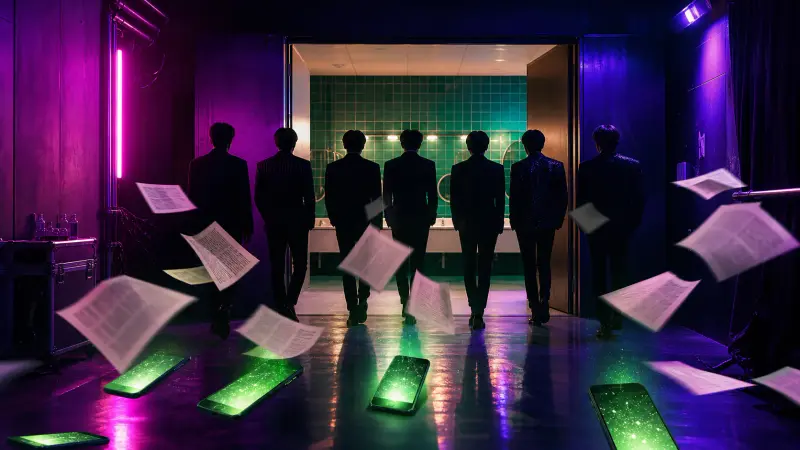
On July 13 and 14, a strange photo of all seven BTS members appeared in the San Francisco Chronicle and the New York Post. Styled like a suspicious late-night news story, the advertisement showed the group facing a row of urinals and asked whether the situation was entirely “normal.” The answer arrived with a sharper hook than the bathroom joke: this was a launch campaign for the “Normal” music video, and Spotify would control the first door.
Big Hit Music announced that the video will arrive on Spotify at 1 p.m. KST on Friday, July 17. Billboard and Music-News.com reported that the video and new release will stay exclusive to Spotify before moving to all major streaming platforms on Sunday, July 19. That creates a two-day first-look window around a song fans already know. The question is not whether BTS can attract attention. It is what happens when one of the world's largest K-pop fandoms is asked to move that attention through one platform first.
The bathroom ad made an old newspaper feel like a fandom alarm
The mystery worked because it looked too strange to ignore
The campaign began in print, not on a feed. Billboard reported that the San Francisco Chronicle carried the ad on July 13 and the New York Post followed on July 14. The fake-news framing offered no conventional comeback copy, no release calendar and no clean hero image. It gave fans a deliberately awkward scene and a date.
That scene became legible when HYBE Labels posted the official “Normal” teaser. UPI described RM entering a restroom already crowded by the other members. The Korea Herald said Big Hit Music intended the setting to reveal an unfiltered, everyday side of BTS in contrast with the group's polished stage image.
The clever part was not simply putting superstars in an ordinary room. It was letting print create uncertainty, YouTube explain the visual, and Spotify own the payoff. Each medium received a different job. The newspaper stopped the scroll before there was a scroll; the teaser turned confusion into a shareable joke; the platform window converted that curiosity into a deadline.
The real hook is not the restroom — it is the clock
“Normal” is being relaunched without pretending it is a new song
“Normal” first appeared on BTS's fifth album, Arirang, in March. The Korea Herald and The Chosun Daily both reported that the alternative-pop track reached No. 41 on the Billboard Hot 100 chart dated April 4. In other words, this is not a rescue operation for an invisible B-side. It is a second event built around a song that already proved it could chart.
Friday's package adds more than a video. Big Hit Music told Korean media that three new versions will arrive alongside it, including the Korean-language version first heard during BTS's Busan concert and an instrumental version. Billboard also identified Ryan Tedder as the track's producer and described its heavy kick-and-snare opening, psychedelic guitar texture and conversational sing-rap.
The release window changes the emotional order. Fans do not need Spotify to discover that “Normal” exists; they need it if they want to participate at the first possible moment. That distinction turns a familiar song into a timed event. The asset is the music video, but the product being tested is urgency.
 Codex-generated editorial image visualizing a timed platform gate opening into global fandom distribution; no real people are depicted.
Spotify is buying behavior, not only streams
A first-look window can teach fans a new route to music video
YouTube has trained K-pop fandoms to treat a music video premiere as a public scoreboard. Views rise in one visible place, reaction videos spread around it, and links are easy to share outside the platform. A Spotify-first video asks the same audience to form a different habit: open the music app, find the visual, watch it where the audio already lives, then stay close to the versions, playlist and artist page around it.
That makes this rollout more valuable to Spotify than a normal promotional banner. BTS brings an audience large enough to make a product decision feel like a cultural event. If fans follow the first-look window, Spotify gains more than plays. It gets evidence that exclusive visual access can redirect fandom traffic inside a service still understood primarily as an audio destination.
BTS receives a different benefit. The group can reopen the Arirang conversation without announcing another album or pretending that March never happened. One odd photo, one teaser, three new versions and one deadline give “Normal” a second launch curve. This is event design applied to catalog, not just comeback marketing.
The gatekeeper strategy can create friction as quickly as urgency
Exclusivity concentrates attention, but fandom does not stay inside one app
The strategy is powerful because it makes the first moment scarce. It is risky for the same reason. Fans are global, platform habits vary, and the conversation will immediately spill into short clips, screenshots, translations and reaction posts elsewhere. The window may concentrate official viewing on Spotify, but it cannot contain the culture around the release.
That tension creates the real test. If the two-day lead makes the wider Sunday release feel bigger, the exclusivity will have worked as a spark. If fans experience the first look mainly as an obstacle, the campaign may generate attention while weakening the emotional promise of access. MEARROW is not assuming either result before the window opens; the meaningful evidence will be how the conversation travels from Friday to Sunday.
The rollout also arrives while BTS is already proving that one event can activate much more than a venue. Related: BTS's London return became a citywide fandom test. The same operating logic appears here at smaller scale: give fans one central moment, then design multiple paths for participation around it.
MEARROW's view: a B-side just became a distribution laboratory
Smaller teams cannot copy BTS's scale, but they can copy the sequence
MEARROW reads the “Normal” campaign as a platform experiment disguised as a visual joke. Its sequence is unusually clean: interrupt attention with an image, delay the explanation, reveal a platform-specific first look, then reopen distribution two days later. Every step creates a new reason to talk about the same song.
Most artists cannot buy mysterious newspaper placements and expect the internet to investigate. They can still learn from the architecture. A rollout works harder when the visual hook, deadline and required fan action point in the same direction. Too many campaigns scatter attention across unrelated concept photos, challenges and preorder reminders. “Normal” compresses the message into one question: do you want to see it first?
The timing also matters for BTS. Arirang has already produced album, chart and tour narratives. Relaunching a proven track through a Spotify-first video tests whether the group can turn its catalog into a sequence of platform events rather than letting the album cycle fade between concerts. If it works, the industry will not copy the bathroom. It will copy the window.
What happens when the door opens everywhere?
Sunday will reveal whether scarcity expanded the story
Friday belongs to the first look. Sunday belongs to distribution. The most important outcome will not be a single screenshot of a ranking; it will be whether the Spotify-first period gives “Normal” more momentum when the video and release spread to other services.
That is why this campaign deserves attention beyond BTS. It puts an old-media stunt, an official teaser, a global audio platform and a two-day clock into one compact funnel. The bathroom photo made people laugh. The platform decision is what makes the rollout consequential. BTS did not merely announce another video. The group turned “Normal” into a live test of who gets to open the door first.


Comments
0Loading comments...