
Today, March 21, 2026, BTS performed at Gwanghwamun Square in front of Gyeongbokgung Palace. 260,000 fans filled the streets. Netflix streamed the concert live to 190 countries. The world watched a K-pop milestone unfold.
What the world didn't see — or only glimpsed at the edges — was the security operation running underneath it all.
Bomb threats. A terror alert. 15,000 personnel. Anti-drone jamming systems. Concertgoers caught at security checkpoints with gas guns, stun guns, and knives.
The concert was a triumph. The operation to make it possible was K-pop's largest-ever mobilization of security, and the story behind it reveals just how consequential BTS's return has become — not just culturally, but politically and operationally.
The Terror Alert: An Unprecedented Step
Why Was a Terror Alert Issued for a K-Pop Concert?
Beginning March 19, Seoul authorities elevated the city's anti-terror monitoring level ahead of the concert. This is not a routine measure. For a K-pop event to trigger an official terror alert adjustment is, by all accounts, without precedent.
Two factors drove the escalation.
First: the volume of bomb threats. In the days preceding the concert, police received multiple credible-enough threats claiming that explosives had been or would be planted at the venue. Each had to be investigated. Each required a coordinated sweep response. The cumulative volume was high enough that authorities could not treat them as mere noise.
Second: the international scale of the crowd. An estimated 260,000 people were expected to gather in one of Seoul's most historically and symbolically significant public spaces. A substantial portion were foreign nationals — fans who had flown in from Japan, the United States, Europe, and Southeast Asia. The confluence of international attendance, global streaming, and symbolic venue made Gwanghwamun Square a high-profile target on any threat-actor's calculus. South Korean security agencies reportedly assessed the risk profile against global threat intelligence.
The Minister of Interior and Safety personally visited the Gwanghwamun venue the day before the concert to inspect safety preparations. A cabinet-level inspection of a K-pop concert venue is itself a first.
Boycott Pressure and Deliberate Disruption
The security challenge was not only external. Domestic opposition to the concert generated its own pressure.
Several groups in South Korea objected to BTS using Gwanghwamun Square — a site of enormous historical and civic weight — for a commercial entertainment event. Others raised concerns about traffic disruption, business impacts from road closures, and crowd management. A smaller number of organized anti-BTS actors attempted to pressure authorities into canceling the concert outright.
Some of the bomb threats police received are believed to have originated from this domestic opposition, deliberately designed to force cancellations or divert police resources. Authorities investigated all threats as real while simultaneously tracking patterns suggesting orchestrated false reporting.
The result: every threat had to be treated as legitimate. The security response could not be scaled back even when a given threat appeared fabricated.
The Scale: What 15,000 Personnel Actually Looks Like
Breaking Down the Numbers
The total safety and security personnel deployed for the concert exceeded 15,000 individuals.
| Category | Estimated Count |
|---|---|
| Police officers | ~6,500–7,000 |
| Plainclothes detectives | Hundreds |
| HYBE private security | ~4,000 |
| Fire and medical response | Hundreds |
| Other safety personnel | Remainder |
| Total | 15,000+ |
For context: this exceeds the security mobilization for the 2002 FIFA World Cup street celebrations in Seoul — which also occurred in and around Gwanghwamun. For a single K-pop concert, it is the largest such operation ever recorded.
Anti-Drone Systems: The Sky Was Locked Down Too
Security at Gwanghwamun wasn't limited to street level.
Police and military units deployed drone detection and radio-frequency jamming equipment around the entire concert zone. Any unauthorized drone approaching the venue's airspace would be automatically detected and rendered non-functional via signal jamming. The systems were designed to neutralize both weaponized drone threats and unauthorized surveillance and filming.
The Civil Aviation Authority established a Temporary Flight Restriction (TFR) covering several kilometers of airspace above central Seoul. The concert airspace was effectively sealed from above.
K-9 sniffer dogs swept the venue and surrounding structures repeatedly in the hours before the concert. Metal detectors were positioned at every entry point. All bags were subject to full inspection. There was no fast lane into Gwanghwamun on March 21.
Subway Lockers Closed Across 17 Stations
Among the more unusual security measures: subway station lockers across 17 Seoul Metro stations — including Gwanghwamun and Gyeongbokgung stations — were taken offline for the day.
The concern was straightforward: public lockers in a densely crowded area represent an obvious concealment point. With tens of thousands of international fans arriving with luggage who might have used lockers as a matter of convenience, the risk of misuse was deemed sufficient to shut them all.
The decision created practical difficulties for fans who had traveled long distances and needed somewhere to store luggage. But from a threat-mitigation standpoint, the measure was non-negotiable.
What Was Found at the Gates
Gas Gun and Stun Gun at the Security Checkpoint
The preventive measures worked — and the checkpoint catches illustrated exactly why they were necessary.
According to Seoul Economic Daily and multiple Korean news sources, a woman in her 50s was arrested at a security checkpoint after being found in possession of a gas gun and a stun gun. She reportedly identified herself as a BTS fan. The weapons were confiscated and she was immediately detained for questioning.
Whatever her intent, the presence of a gas-firing weapon and an electrical-shock device at a venue hosting 260,000 people, with multiple international broadcast feeds, represents a serious threat event. The checkpoint system caught it.
Knives and Other Weapons: Multiple Seizures
The gas gun incident was not isolated. Multiple individuals were stopped at security checkpoints carrying knives — some described as small folding knives, others as utility blades. Individuals who offered explanations — "it's for camping," "I forgot it was in my bag" — had the items confiscated regardless. Police conducted on-site questioning of all individuals found carrying weapons.
The scope of the seizures across the entry points marked a new threshold for K-pop event security. While most incidents likely involved genuine oversight rather than malicious intent, every seized item validated the checkpoint infrastructure.
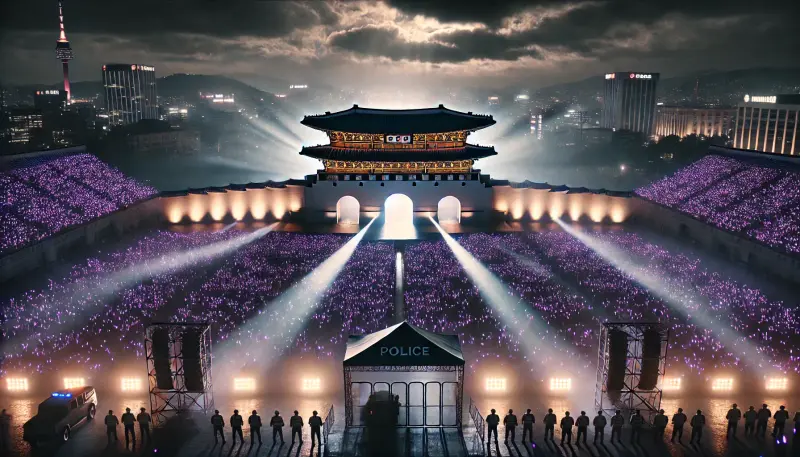 Image: AI generated via ChatGPT
The Concert Went On
Despite Everything, BTS Took the Stage
At 1 PM KST, BTS stepped onto the Gwanghwamun stage in front of Heungnyemun Gate. The concert ran without a security incident. The Netflix stream reached 190 countries.
After the event, a police spokesperson confirmed that no serious security incidents occurred during the concert period. The operation held.
260,000 people went home safely. The world's largest K-pop live event — by security mobilization, by global audience reach, and arguably by cultural significance — was complete.
What "No Incidents" Cost
The absence of an incident is not the absence of a threat. It is the result of preparation.
Months of joint planning between HYBE, Seoul Metropolitan Government, the Seoul Metropolitan Police Agency, and national security agencies produced the security architecture that made today possible. The gas gun was caught. The knives were caught. The bomb threats were investigated and contained. The drones stayed away.
This is the cost of K-pop at scale. And it is a cost that will only increase.
Industry Implications: K-Pop Is Now a National Security Event
The Threshold Has Shifted
The Gwanghwamun concert marks a definitive shift in how major K-pop events must be conceptualized and planned.
A cabinet minister on-site. A national terror alert adjusted. Anti-drone military equipment deployed. Subway infrastructure taken offline across 17 stations. These are not concert logistics. These are state-level event management operations.
BTS's return has elevated K-pop into territory that no other music industry has been asked to occupy: the intersection of mass entertainment, global media distribution, and national security infrastructure. When 260,000 people gather in one of the world's most symbolic public squares, and when 300 million Netflix subscribers worldwide have access to the event in real time, the stakes are no longer just cultural.
What This Means for the ARIRANG World Tour
The Gwanghwamun concert was the opener. The ARIRANG World Tour — 34 regions, 82 shows, running from April 2026 through March 2027 — is the main event.
Each stadium date in New York, Los Angeles, London, Paris, Tokyo, and São Paulo will carry its own security calculus. International venues and local law enforcement will be coordinating with HYBE security on event profiles that reflect what Seoul demonstrated today: a BTS concert is not a standard concert. It is a high-profile public gathering with a documented history of threat generation.
The precedent is set. For every future large-scale K-pop event — not just BTS, but potentially Stray Kids, BLACKPINK, aespa, and others operating at stadium scale — the Gwanghwamun operation defines the new baseline for what responsible security looks like.
MEARROW Perspective
In MEARROW (K-pop Talent Network) terms, today's events reinforce a structural point about HYBE's position: BTS does not merely generate revenue. BTS generates national-scale logistical requirements. That is both a measure of their influence and a constraint that no other K-pop act currently faces at the same magnitude.
The security costs for the ARIRANG tour will be significant. HYBE and partner promoters globally will be building security budgets that reflect today's Gwanghwamun template — not the pre-military-service BTS tour model from 2019.
That cost is ultimately reflected in ticket prices, tour logistics, and insurance. It is the tax on being the most significant live entertainment act in the world.
Conclusion: The Operation No One Saw
The concert at Gwanghwamun was beautiful, historic, and emotional.
The operation that made it possible — 15,000 security personnel, anti-drone jamming, subway lockdowns, a national terror alert, and a woman with a gas gun stopped at the gate — was invisible to most viewers.
That is how security is supposed to work. The success of an operation is measured in what didn't happen.
On March 21, 2026, at Gwanghwamun Square: nothing happened. BTS sang. 260,000 people watched. The world tuned in.
That is the whole story — and the hidden one.


Comments
0Loading comments...