

BTS Guinness ICONS is not a nostalgia badge. It is a timing problem for everyone still trying to explain BTS as a peak that already passed. Guinness World Records' current ICONS page places BTS in the Pop Culture lane near names such as Taylor Swift, Beyonce, Drake, Elton John and Paul McCartney. At the same time, ARIRANG has reached its eighth straight week inside the Billboard 200 top 10, sitting at No. 8 on the May 17 update. The obvious story is another fan celebration. The sharper question is why a No. 8 chart position suddenly looks more dangerous than a No. 1 debut. Related: BTS kept 13 songs on Billboard for 7 weeks
BTS Guinness ICONS Is Bigger Than A Trophy Page
The list changes the frame
Guinness World Records describes its ICONS project as a way to spotlight record holders who have helped shape the world around them. BTS appears in the Pop Culture category, not as a temporary viral act but as a group whose records now sit inside a wider cultural archive. The group's own ICONS page lists South Korea as its nationality, marks BTS as inducted in 2024, and names three notable records: most followed act on Spotify among duos or groups, most streamed act on Spotify among duos or groups, and first K-pop act to reach No. 1 on the U.S. albums chart.
That last record is the key. Love Yourself: Tear made BTS the first K-pop act to top the U.S. albums chart in 2018. Guinness also points to Dynamite becoming the first K-pop track to reach 1 billion Spotify streams. Those are not just old milestones. They are the foundation that lets a 2026 chart run feel less like a comeback surprise and more like the next chapter in a documented pattern.
The No. 8 Detail Is The Real Flex
Week eight is harder to fake than week one
On May 17 local time, Billboard announced that ARIRANG was spending its eighth consecutive week in the Billboard 200 top 10 at No. 8, according to Soompi's report citing Billboard. Soompi also reported that the album earned 44,000 equivalent album units in the week ending May 14, based on Luminate data, and became the first album by a Korean artist to spend eight weeks in the chart's top 10.
That is why the number matters. A debut can be powered by preorders, concentrated fandom buying and a first-week media wave. An eighth top-10 week asks a different question: are enough people still listening, buying, discussing and returning after the fireworks are over? For BTS, the answer is still yes. No. 8 sounds smaller than No. 1, but in week eight it behaves like proof of endurance.
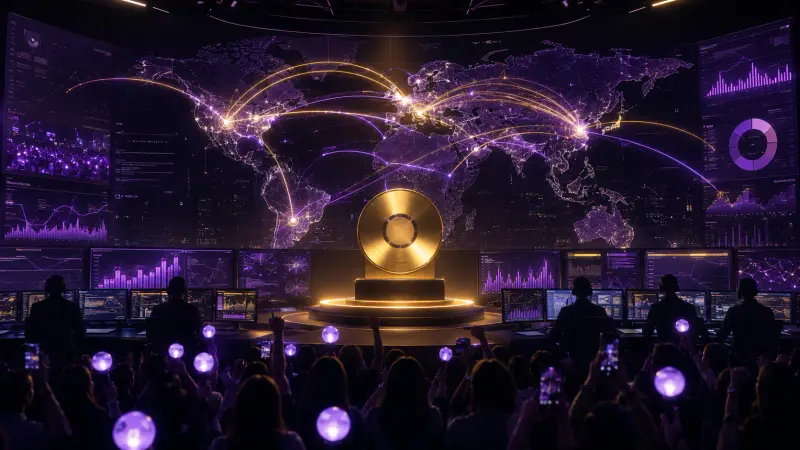 A ChatGPT-generated editorial visualization of BTS record culture, global charts and fandom momentum without real faces or official logos.
ARIRANG Turned Chart Math Into Culture
The album run started with scale, then survived on behavior
The current run did not come from a quiet launch. Korea JoongAng Daily reported that ARIRANG debuted at No. 1 on the Billboard 200 for the chart dated April 4, giving BTS its seventh No. 1 album on the chart. The same report said Billboard credited the album with 641,000 equivalent album units in its opening week, including 532,000 pure album sales. Seoul Economic Daily framed that opening as the largest week for an album by a group since the Billboard 200 began using equivalent album units in late 2014.
Those opening numbers were massive, but the more useful business signal is what happened afterward. ARIRANG did not disappear once the launch receipts were collected. It kept giving fans material to organize around: album tracks, chart debates, tour context, physical formats, remix behavior, and the larger question of whether BTS can still make a full-group album feel like a global event after military-era uncertainty.
The record page and the chart page feed each other
This is where Guinness and Billboard become the same story. Guinness turns BTS into an archived example of K-pop history. Billboard turns that history into a live scoreboard. One tells readers that BTS already changed the record book. The other tells readers that the record book is still moving.
For fans, that combination is powerful because it compresses past and present into one shareable argument. BTS are not only remembered for breaking through in 2018. They are still producing numbers in 2026 that force new context around that breakthrough. For the wider market, the lesson is less emotional and more uncomfortable: K-pop's biggest fandom is still converting memory into measurable weekly behavior.
Why This Topic Hit The Timeline So Fast
Prestige travels differently from promotion
Comeback teasers create urgency. Award nominations create debate. A Guinness ICONS placement creates a different kind of spread: status confirmation. It gives fans a clean screenshot-friendly frame and gives casual observers a reason to revisit the scale of records they may have stopped tracking. That matters because fandom culture does not only move through new content. It also moves through proof that the old content was bigger than outsiders admitted.
The No. 8 Billboard detail adds tension to that proof. Without the chart result, the ICONS page could be read as a legacy honor. With the chart result, the story becomes active: BTS are being archived while still competing near the top of the most important U.S. album chart. That is a rare position for any pop act, and it is especially sharp for a Korean group whose global ceiling has supposedly been redefined several times already.
The comparison set is brutal
Being listed in Pop Culture near Taylor Swift, Beyonce, Drake, Elton John and Paul McCartney does not mean every name is equivalent in every metric. It means Guinness is placing BTS in a room where the comparison set is no longer only K-pop. That is the real shift. The group is being read beside global pop institutions, digital-era fan engines and long-running catalog powers.
For K-pop companies, that matters because it changes the benchmark for ambition. The target is not only a No. 1 debut, a viral dance challenge or a sold-out arena. The harder target is becoming culturally durable enough that a record institution can archive the act while the charts are still proving present demand.
MEARROW's View: No. 8 Is Where The Story Gets More Useful
Durability beats peak worship
MEARROW reads the current moment as a warning against peak worship. The industry loves launch-week trophies because they are easy to market. Week-eight strength is harder to package, but it is more valuable. It shows whether a release can keep fans organized after the countdown ends, whether the album still creates repeat behavior, and whether cultural prestige can keep reinforcing commercial performance.
That is why the Guinness-Billboard overlap is so clickable. It is not just "BTS made another list." It is "BTS made the list while the numbers are still alive." For trainees, rookie teams and smaller agencies, the lesson is practical: the goal is not only to create a loud opening. The goal is to build a story that fans can keep defending, explaining and expanding after the first week has lost its novelty.
The Question After The Screenshot
Can anyone else build this kind of memory machine?
BTS are now operating in a rare lane where records, charts and fandom memory reinforce each other. The Guinness page gives the group institutional language. The Billboard 200 run gives the group fresh movement. The fanbase turns both into cultural ammunition.
The next question is not whether BTS can still create a headline. They clearly can. The next question is whether another K-pop act can build the same layered machine: a history that institutions recognize, a present that charts can still measure, and a fandom that knows how to turn No. 8 into something louder than most No. 1s.


Comments
0Loading comments...