
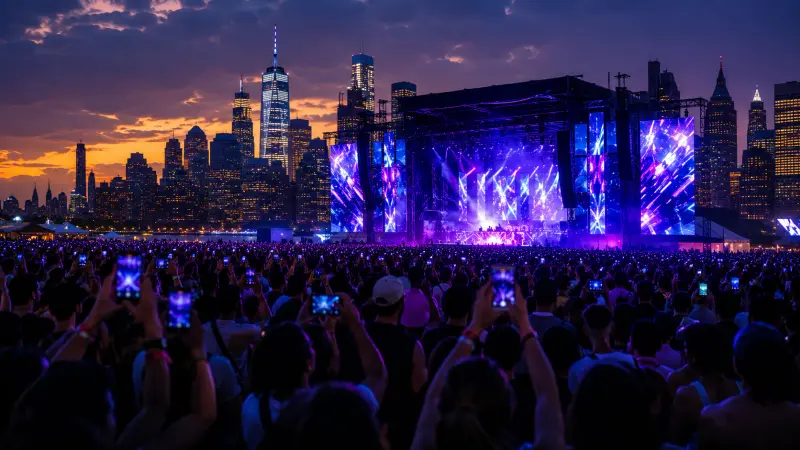
Gov Ball K-pop is not a side note anymore. Across June 5–7, New York’s Governors Ball placed Stray Kids, Jennie and KATSEYE inside the same festival weekend, turning what could have been three separate fan stories into one broader market signal. The sharper question is not whether K-pop can appear on a U.S. festival poster. That question is already old. The harder test is whether K-pop acts can make a mixed festival crowd behave like a fandom-driven event without losing the casual audience standing beside it. Related: Stray Kids' seven-member Gov Ball risk test
The Poster Stopped Treating K-pop As A Guest Slot
Three acts created one weekend story
CBS New York listed the 2026 Governors Ball as a three-day festival at Flushing Meadows Corona Park, with Stray Kids, Jennie and KATSEYE all sitting inside the weekend schedule. Yahoo Entertainment framed the same bill as the festival’s most K-pop and global-pop-forward lineup so far, pointing to the way Stray Kids, Jennie and KATSEYE changed the shape of the roster.
That is the shift. K-pop is no longer being presented as one imported novelty act added for online buzz. The weekend had a veteran performance machine in Stray Kids, a BLACKPINK solo megabrand in Jennie, and a global girl-group experiment in KATSEYE. Those are different business models, but Gov Ball put them into the same field and asked the same question: who can convert global online attention into real festival gravity?
The timing made the signal louder
The festival ran June 5–7, while K-pop conversation was already overloaded by comeback schedules, tour clips and fan voting cycles. That timing matters because fandom labor has limits. Fans can stream, translate, clip, post, buy, argue and travel, but they cannot give every campaign the same intensity forever.
A festival weekend cuts through that noise because it creates visual proof. You can see the crowd. You can see the phones. You can see whether a non-fandom audience stays, leaves, sings along or simply records the moment because everyone else is recording it too. That kind of evidence is harder to fake than a hashtag spike.
Why This Is Bigger Than A Headliner Poster
Festival crowds are mixed-market auditions
Billboard reported earlier this year that A$AP Rocky, Lorde and Stray Kids were among the Governors Ball headliners. By the time the weekend arrived, the lineup had become a practical audition for K-pop’s U.S. festival future. A tour crowd buys into the act before the lights go down. A festival crowd is less loyal and more chaotic: some people came for another headliner, some came for the park, some came because a friend had a ticket, and some came only because the clip might go viral.
That is exactly why the stage is valuable. If Stray Kids, Jennie or KATSEYE can pull attention from people who did not enter as dedicated fans, they are not only proving fandom strength. They are proving conversion power. For agencies, promoters and sponsors, that may be the more important number.
Fans do more than watch the stage
K-pop fans arrive with an operating system. They know the setlist rumors, the member context, the camera angles, the fan chants, the outfit references and the moments most likely to travel on short-form video. At a festival, that behavior changes the atmosphere for everyone nearby. A casual listener may not know the lore, but they can feel when a crowd has already decided that a moment matters.
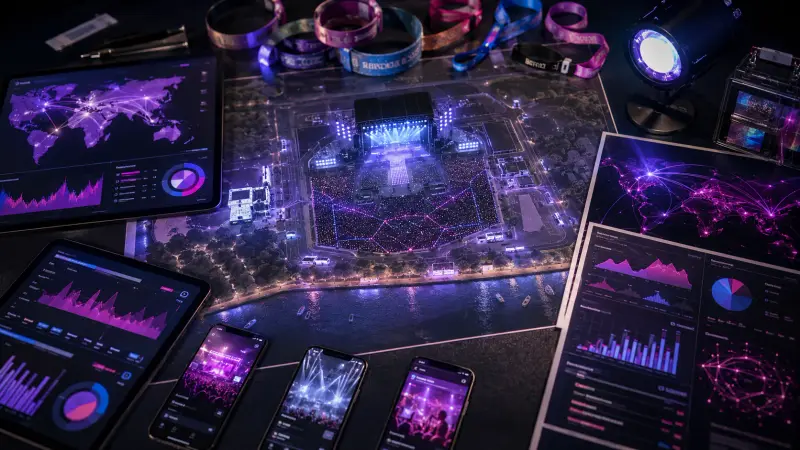 ChatGPT-generated editorial image representing how festival crowds, phone clips and fan-engagement data turn a live K-pop stage into a market signal.
The catch is that the same fandom engine can also expose weak staging. If the sound mix, pacing or camera-ready moments do not land, fan clips spread that too. Festivals reward scale, but they punish dead air. K-pop’s advantage is preparation. Its risk is that the preparation has to survive weather, mixed crowds, shortened sets and outdoor production limits.
The Seven-Member Context Still Matters
Stray Kids carried the milestone with a health footnote
Gov Ball was not a clean victory lap for Stray Kids. The Korea Herald reported that Seungmin would miss the New York performance after JYP Entertainment said he had been diagnosed with a stress fracture in his left ankle and could not take long flights. Soompi also reported that the group would perform at Governors Ball as seven while Seungmin focused on treatment and recovery.
That context changes how the milestone reads. A headliner slot is a scale signal, but a missing member turns it into a sustainability signal too. The question is not whether Stray Kids can adapt. They can. The real question is whether K-pop’s global live calendar can keep expanding without turning recovery windows into narrative damage.
The best signal is care plus scale
For fans, the healthiest version of this weekend is not a fantasy where every schedule goes perfectly. It is a more adult version of success: the stage lands, the absent artist receives real recovery time, and the company avoids treating the health notice as a minor footnote once the applause starts.
That is why this Gov Ball story matters beyond one performance. The same weekend that proved K-pop can sit near the center of a major New York festival also reminded fans that scale has a body cost. If the market only celebrates the stage and ignores the recovery math behind it, the model will keep looking stronger than it actually is.
Jennie And KATSEYE Widened The Definition Of K-pop Reach
One weekend carried more than one export model
Jennie’s Gov Ball presence works differently from Stray Kids’ headliner story. She carries the force of BLACKPINK recognition, solo fashion visibility and a fanbase that already understands global festival language. KATSEYE works from another angle: a group designed for global pop conversation but constantly read through the K-pop system that helped shape it.
Putting both into the same weekend makes the label “K-pop” more flexible and more contested. Is the story Korean-language idol music? Korean agency training systems? Fan behavior? Global girl-group infrastructure? Festival promoters may not care about those boundaries as much as fans do. They care whether the act moves tickets, clips and crowd density.
That ambiguity is now part of the product
This is where the weekend becomes more interesting than a simple “K-pop is popular” headline. K-pop’s global reach is no longer one lane. It can look like Stray Kids commanding a performance-heavy fandom. It can look like Jennie carrying solo celebrity gravity. It can look like KATSEYE testing whether K-pop-shaped training and global-pop positioning can share the same stage vocabulary.
For MEARROW, that ambiguity is not a weakness. It is the market’s next shape. The more K-pop expands into festivals, sports events, fashion platforms and streaming campaigns, the less useful the old border becomes. The stronger question is which parts of the K-pop machine travel: choreography precision, fandom coordination, visual storytelling, platform strategy or the emotional contract between artists and fans.
MEARROW's View On Gov Ball's K-pop Weekend
The real win is repeatable festival grammar
MEARROW reads Gov Ball 2026 as a test of repeatability. One loud festival weekend is valuable, but the industry will care more if the format can be repeated without needing a once-in-a-year lineup collision. Can K-pop acts keep converting casual festival crowds? Can promoters program them across different stages without isolating them as niche slots? Can fanbases support the moment without exhausting themselves before the next campaign begins?
The answer will not come from one setlist. It will come from the afterlife of the weekend: clips that keep moving, press that reaches outside fandom circles, sponsor interest, tour-routing confidence and whether future festivals treat K-pop acts as structural draws rather than decorative global flavor.
The risk is mistaking visibility for permanence
Gov Ball gave K-pop a huge visual win, but visibility is not the same as permanence. A festival crowd can cheer loudly and still move on by Monday. The acts that turn this weekend into durable value will be the ones that convert attention into the next action: a new listener following the catalog, a casual attendee buying a tour ticket, a promoter booking another K-pop-heavy day, or a brand deciding that fandom coordination is worth paying for.
That is the real test nobody can ignore. K-pop already knows how to create a moment. Gov Ball asked whether it can create a weekend that still matters after the park empties.
The Question After Queens
The next festival poster will tell the truth
Queens gave K-pop a crowded field, literal and strategic. Stray Kids, Jennie and KATSEYE did not represent the same lane, but together they made a stronger argument than any single act could make alone: K-pop’s U.S. festival future is no longer theoretical.
Now the next poster matters. If major festivals keep giving K-pop acts central billing, the Gov Ball weekend will look like an early proof point. If the calendar returns to one isolated token slot at a time, it will look more like a bright spike than a structural change. The stage was big. The more important question is whether the booking logic got bigger with it.


Comments
0Loading comments...